Wedding Planning Checklist: A 12-Month Timeline
A month-by-month wedding planning checklist with lead times for venue, attire, invitations and the marriage license, so nothing slips through.
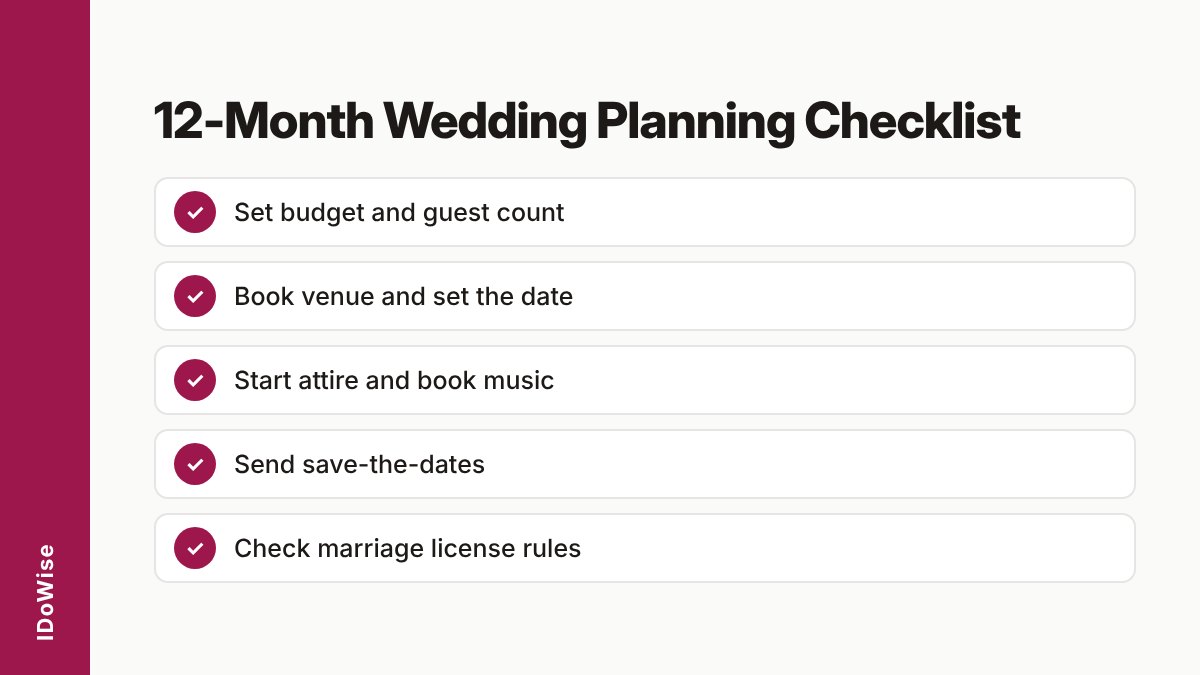
A 12-month wedding timeline works best when you do the decisions that everything else depends on first: budget, guest count, date and venue. After that, the schedule is mostly about lead times, because some items (rentals, attire, invitations) need weeks or months to arrive. This checklist walks through the year in order.
Quick answer: the big milestones
Use this as the short version, then read the month-by-month detail below.
| When | Main goal |
|---|---|
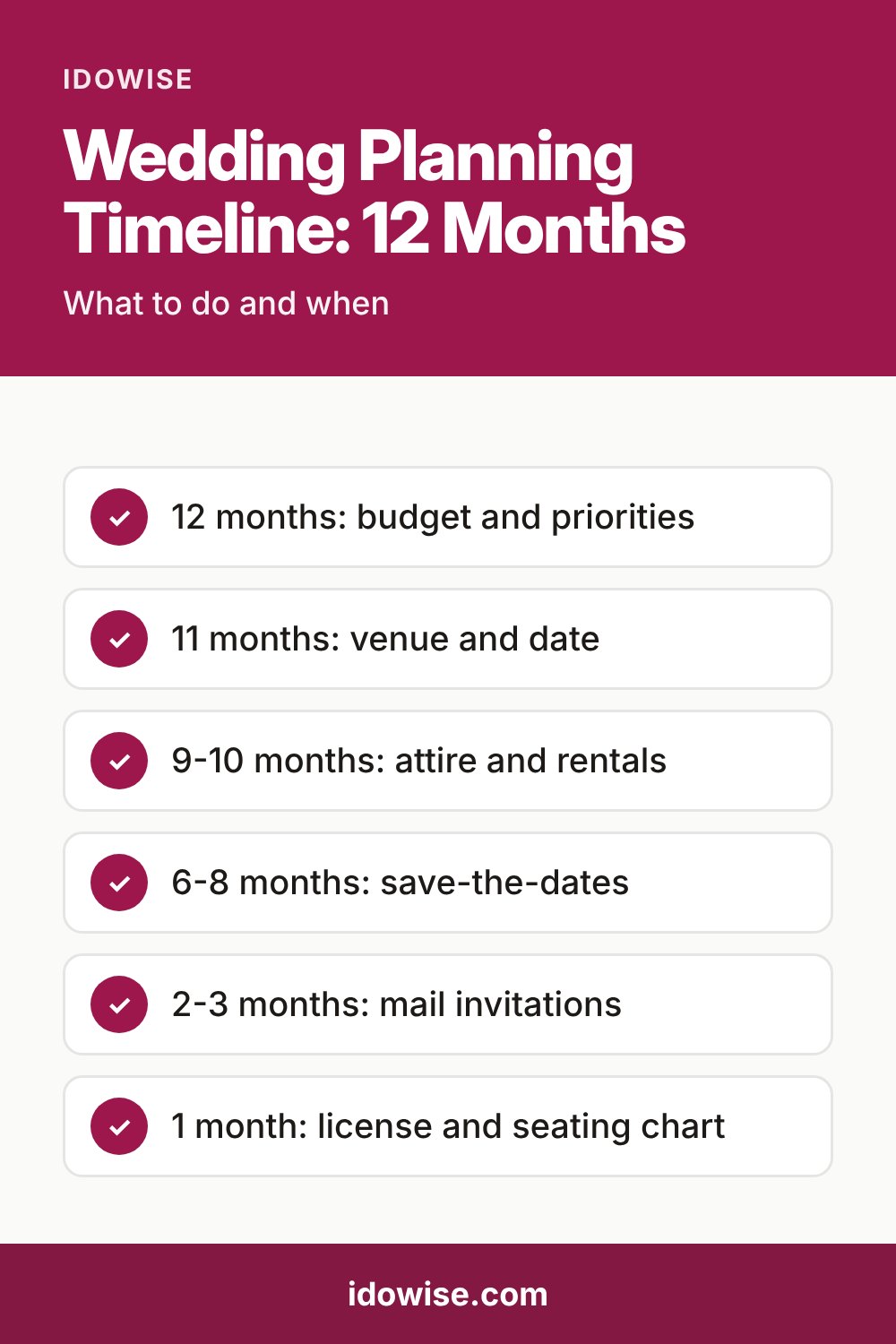
| 12 months out | Set the budget, rough guest count and priorities |
| 11 months | Lock in the date and venue, start booking vendors |
| 9-10 months | Start attire, book music and rentals, reserve hotel rooms |
| 6-8 months | Send save-the-dates, shop for rings, confirm vendors |
| 3-5 months | Order invitations, plan the menu, book an officiant |
| 1-2 months | Finish alterations, complete the license steps, build the seating chart |
| Final week | Give the venue a final headcount and pack |
12 months out: set the foundations
Before you look at a single venue, agree on the basics.
- Talk about money. Decide what you can spend and whether family members are contributing. Ask anyone who is contributing early, so you know the real number.
- Choose your top priorities. Pick two or three things that matter most (for example, food, photography or the venue) so you know where to spend and where to simplify.
- Estimate a guest count. A rough range is enough at this stage. It drives the venue size, the catering and almost every cost.
- Decide whether to hire a planner. A full planner, a partial service or a day-of coordinator each cover different amounts of work, so decide early whether you want one.
- Start researching venues. Weddings cluster in warmer months in many regions, so popular dates can fill quickly.
On costs: wedding prices vary widely by region, season, guest count and day of the week, so this guide does not quote averages. Instead, ask each vendor for a written quote that lists what is included, and compare like with like.
11 months out: date, venue and guest list
Lock in your date and venue together, since the venue’s availability usually decides the date. After that, book other vendors in order of how quickly they sell out. Choose your wedding party, finalize a first-draft guest list and start collecting mailing addresses so you are not chasing them later.
9-10 months out: attire, music and rentals
Start shopping for attire. Gowns often take months to be ordered and altered, while suits generally need a shorter window. Reserve hotel room blocks for out-of-town guests, since some hotels only hold rooms provisionally until roughly a year before the event. Book your band or DJ, and reserve rentals (tables, chairs, linens), which can need 9-12 months of lead time at busy times. This is also a good time for engagement photos.
6-8 months out: communicate and confirm
- Build a wedding website and registry.
- Send save-the-dates. These can go out well ahead of the wedding, which helps guests who need to book travel.
- Consider wedding insurance and start thinking about the honeymoon.
- Order attire for the wedding party at least three months ahead.
- Confirm every vendor in writing.
- Shop for wedding bands, which can take around six to eight weeks.
- Check that passports are valid if you are traveling abroad.
- Book hair and makeup, and finalize your invitation design.
3-5 months out: invitations, menu and ceremony
| Task | Timing to aim for |
|---|---|
| Order formal invitations | About 5 months out |
| Mail invitations | 2-3 months before (4-6 months for destination weddings) |
| Menu planning with the caterer | About 5 months out |
| Book an officiant | About 5 months out |
| Choose ceremony and first-dance music | About 4 months out |
| Order personalized details and print programs | 3-4 months out |
| Hair and makeup trial | About 3 months out |
Set an RSVP deadline on the invitation that is comfortably ahead of your final headcount date to the venue, so you have time to follow up with anyone who has not replied.
1-2 months out: finishing touches
- Alterations. Allow at least four to six weeks for final fittings and adjustments.
- Marriage license. Check the rules now rather than later (see the next section).
- Seating chart. Draft it once most RSVPs are in.
- Favors and welcome bags. Order them early enough to ship and be delivered.
- Vows. Start writing them if you are personalizing them.
- Pre-wedding events. Plan any bachelor or bachelorette celebrations and confirm shower dates.
The marriage license: check your local rules
Marriage license rules differ from place to place, so confirm yours with your local registry office or the vital records office in the place where you will marry. Do not rely on a general checklist for the details.
Here is what the official pages listed under Sources say:
- In the United States, a license is the permission to marry, while a certificate is the record that proves the marriage took place. USA.gov says a license can expire anywhere from about 30 days to a year after it is issued, depending on the state, and that you should contact the vital records office in the state where you plan to marry.
- In England and Wales, GOV.UK says notice of marriage must be given at least 29 days before the ceremony and the ceremony must take place within 12 months of giving notice. Notice is given in person at a register office, usually by appointment.
- If you are marrying in Canada, Australia or another country, use that country’s or region’s official registry or government page, and allow extra time if either of you is a non-resident or needs to provide documents from abroad.
The practical rule: find out the waiting period, the expiry date and the documents required as soon as you have a date, then put the application deadline in your calendar.
Final week and the day before
- Give the venue your final headcount.
- Confirm arrival times with all vendors and share a one-page schedule.
- Pack outfits, rings, vows and any documents you need.
- Prepare vendor tips and thank-you gifts in labeled envelopes.
- Drop off decor and run through the ceremony at the rehearsal.
- Hand the rings and the license paperwork to the officiant or the person responsible for them.
Common mistakes
- Booking details before the date and venue are set. Many vendors cannot confirm until the date is fixed.
- Skipping written confirmations. Verbal promises are easy to forget; ask for dates, times and what is included in writing.
- Leaving attire late. Ordering and fitting take longer than most people expect.
- Assuming license rules match a friend’s. They differ by location, so check your own.
- No buffer in the schedule. Leave breathing room for photos, travel and the unexpected.
If you have less than 12 months
Keep the order and compress it. Spend the first week on the budget, guest count and venue shortlist. Book the venue, officiant and any high-demand vendors first, then run attire, invitations and the license steps at the same time. Choose vendors who can confirm their availability quickly, and consider a smaller guest list to reduce the number of decisions.
Sources
Frequently asked questions
Is 12 months enough time to plan a wedding?
Yes, for most weddings. The order matters more than the length: set the budget and guest count first, then book the venue, then everything that depends on the date.
What should I book first?
The venue and date, because most other vendors can only be booked once those are fixed. Popular venues are often the first to fill, especially in peak months.
When should I apply for a marriage license?
It depends entirely on where you marry. Some places set a waiting period and some licenses expire, so ask your local registry office well before the wedding.
What if I have less than 12 months?
Keep the same order but compress it. Book the venue, the officiant and the key vendors in the first few weeks, then work through attire and invitations in parallel.